

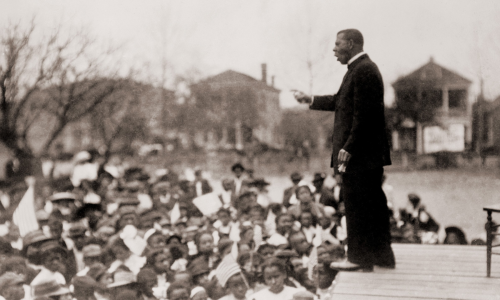
Booker T. Washington entered this world with no recorded birthday and no recorded father. He was born on a Virginia plantation before the Civil War, a slave from his very first breath, with no paper trail proving he existed and no name given to him that anyone bothered to write down. By every measure the world uses to establish a man’s worth—birth certificate, lineage, or inheritance—Washington had nothing. And yet, he became the founder of Tuskegee Institute, the author of an enduring American autobiography, and one of the most respected voices of his generation.
He is remembered chiefly today as the man who built Tuskegee Normal and Industrial Institute in Alabama from almost nothing in 1881 into a thriving center of vocational education for freedmen and women. He is remembered for his 1895 Atlanta address, in which he urged Black Americans toward economic self-reliance and skill-building as the path forward—a strategy that made him the most influential Black leader of his era, even as others pushed for a swifter, more direct fight for civil rights. And he is remembered most enduringly through his autobiography, Up From Slavery, the firsthand record of a man who rose from bondage to national influence not through bitterness, but through disciplined, quiet perseverance.
A man with no recorded birth left behind one of the most well-documented legacies in American history.
My friend, the circumstances of our birth, the wounds inflicted on our bodies, and even the chains placed on our flesh never have to define the freedom of our souls. Washington understood this distinction:
“I have been a slave once in my life—a slave in body. But I long since resolved that no inducement and no influence would ever make me a slave in soul, in my love for humanity, and in my search for truth.”
Read that again slowly. Washington’s body had been owned and worked without his consent. But his soul—his capacity to love, to reason, and to express the real part of himself—would, he declared, never belong to any human master. He understood that bondage could reach the body, but it could never fully reach the soul unless the soul allowed it. This is not just a history lesson. This is a spiritual truth directly addressed in God’s Word:
“Do you not know that to whom you present yourselves slaves to obey, you are that one’s slaves whom you obey, whether of sin leading to death, or of obedience leading to righteousness.” (Romans 6:16)
Every one of us is a slave to something. Not metaphorically—actually. Whatever we repeatedly yield to, whatever command we obey without question, that is our master. Washington’s body was mastered by a plantation owner—one he didn’t even choose. Many of us have bodies and minds mastered by things we DO choose—bitterness, addiction, fear, the endless appetite of the flesh for comfort or control. The mind of the flesh does not ask permission before it demands obedience; it simply makes harsh demands, day after day, until we call its commands “just who I am.”
But here is what Washington’s testimony and Paul’s teaching both insist on: Our born again souls no longer have to obey the flesh. The flesh can be starved, chained, exhausted, and even enslaved by circumstances entirely outside our control—and still the soul, born again and made righteous in Christ, remains free. Our struggle is a battle over what the will of the flesh will be permitted to command. Paul described this exact war in his own members (or body):
“For I know that in me (that is, in my flesh) nothing good dwells; for to will is present with me, but how to perform what is good I do not find. For the good that I will to do, I do not do; but the evil I will not to do, that I practice. Now if I do what I will not to do, it is no longer I who do it, but sin that dwells in me. I find then a law, that evil is present with me, the one who wills to do good. For I delight in the law of God according to the inward man. But I see another law in my members, warring against the law of my mind, and bringing me into captivity to the law of sin which is in my members. O wretched man that I am! Who will deliver me from this body of death? I thank God—through Jesus Christ our Lord!” (Romans 7:18–25)
Notice that Paul does not say, “I love sin.” He says it is sin dwelling in his flesh, warring against the mind that delights in God’s law. Booker T. Washington resolved that his soul would not be mastered even while his body was. We have this great resolution available to us, because Christ has already declared it finished.
“Therefore if the Son makes you free, you shall be free indeed.” (John 8:36)
The application is not abstract. Ask yourself honestly what you obey without a fight—what voice, what craving, or what old wound gets to dictate your next move. Obedience reveals your master. If it is anything other than righteousness, the invitation is not to try harder in your own strength, but to present yourself again to the Master who already purchased your soul’s freedom. Paul takes this word “present” and turns it into an invitation instead of a warning:
“I beseech you therefore, brethren, by the mercies of God, that you present your bodies a living sacrifice, holy, acceptable to God, which is your reasonable service. And do not be conformed to this world, but be transformed by the renewing of your mind, that you may prove what is that good and acceptable and perfect will of God.” (Romans 12:1–2)
The same body that could be presented as a slave to sin can instead be presented as a living sacrifice to the most loving Master. The same mind that the flesh tries to command can be renewed by Him. This is not passive freedom. It is freedom that requires daily, deliberate submission to God rather than anything less than Him.
Booker T. Washington’s other famous phrases are worth remembering because they carry this same thread of soul freedom into practical, everyday character. He said, “I have learned that success is to be measured not so much by the position that one has reached in life as by the obstacles which he has overcome while trying to succeed.” A soul that is free doesn’t measure itself against another person’s starting point. It measures faithfulness against the obstacles God has allowed us to walk through.
Tough circumstances may have controlled his body, but rather than allowing them to damage his character, he allowed them to make him a man of greatness.
And on the matter of hatred, which enslaves the soul far more thoroughly than any plantation ever could, he said: “I would permit no man, no matter what his color might be, to force me to stoop so low as to hate him.” He was refusing soul slavery—the slavery of bitterness—after having already been freed from bodily slavery. He understood that hatred is simply another master, and he would not present himself as a slave to it, no matter what he had suffered.
Finally, on the daily discipline of a free soul, he said: “Excellence is to do a common thing in an uncommon way.” Freedom is not usually dramatic. It is usually lived out in ordinary tasks done with extraordinary faithfulness, the same way a soul walks out its righteousness one obedient choice at a time.
What an amazing life Booker T. Washington led. I strongly encourage you to read his autobiography—his own words—rather than someone else’s commentary on his life! His life has challenged me to ask myself:
What is currently mastering my life? Am I still making myself a slave to the flesh, or am I choosing to live in grateful obedience to my eternally loving Master, who purchased my life with His own blood?
Prayer:
Lord, I confess that I have obeyed the flesh in places where I should have obeyed You. My soul is righteous because You made it so, but I struggle with my flesh. Teach me today to present myself as a slave to obedience and righteousness, not to sin. Thank You that no circumstance, no wound, and no chain the enemy places on my body or mind can touch the freedom You have already secured for my soul. Teach me to love You better and desire You more! In Jesus’ name, Amen.






One Response
For whom, the son sets free is free indeed.